 Jack Russell
One Jack Russell Terrier barks when a dog appears but can turn away across the street. Another becomes still, stares and lunges when the gap closes. Both may be called aggressive, yet the second picture carries a different margin for error. A useful plan begins with the specific sequence, the available distance and the consequences of a mistake.
Below, we handle the encounter through five decisions rather than a generic socialization ladder. We set the risk margin, choose one of three exits, test calm movement without forcing greetings, manage the home and evidence record, and route bite risk or sudden behavior changes to qualified help. Each decision protects distance before it asks for a trained response.
The Jack Russell Terrier Aggression Margin
Begin with history. Record bites that broke skin, fights requiring separation, redirected bites toward a person, escape attempts and encounters where the handler lost physical control. Those events warrant prompt professional assessment rather than neighborhood experiments.
Use two columns for the initial triage. One names what happened, including distance, contact and injury. The second names what prevented a worse outcome, such as a locked gate, an early street crossing or a second adult. The prevention column reveals protections that must remain active while help is arranged.
The ASPCA's overview of aggression notes that warning may be extremely brief. Watch for closed mouth, sudden stillness, hard stare, forward weight, raised lip, growl or a rapid change in tail and ear position. Do not punish these signals. Removing warnings can leave less information before a bite.
Medical and Handling Baseline
Arrange a veterinary examination when aggression appears suddenly, intensifies or accompanies touch sensitivity, altered movement, sleep changes or appetite changes. Pain and illness can affect tolerance. Keep regular veterinary visits current even when the behavior seems tied to a familiar trigger.
Until risk is assessed, use secure equipment, avoid off-leash areas and choose routes with room to leave. Separate dogs with doors or sturdy barriers when supervision is unavailable. Management is not failure. It stops rehearsal and protects every participant while the plan is built.
The related AKC Parson Russell Terrier standard describes an energetic working terrier and treats overt aggression toward another dog as a disqualification. Breed history may explain quick arousal, but it should never be used to dismiss unsafe behavior as inevitable.
The Traffic Pattern Behind Dog Aggression
Map the encounter like a road junction. Note where the other dog enters view, whether either path narrows, what blocks escape and how quickly the distance changes. A dog who copes across a wide field may struggle on the same block between parked cars.
The table below turns common layouts into early decisions. Read each row before a walk and choose the exit while the environment is quiet. A plan made after both dogs are staring is already late.
- Head-on sidewalk: Common pressure: Closing distance with no curve. Early handler choice: Cross early or turn away. Unsafe choice: Wait until both dogs meet.
- Narrow doorway: Common pressure: Blocked exit and sudden appearance. Early handler choice: Pause behind a barrier. Unsafe choice: Squeeze past on a tight leash.
- Parallel path: Common pressure: Changing speed and side glances. Early handler choice: Use a wide offset. Unsafe choice: Drift closer each minute.
- Fence line: Common pressure: Fast movement and barrier frustration. Early handler choice: Move out of sight. Unsafe choice: Practice beside repeated charging.
Observe the Jack Russell Terrier before the visible outburst. A slower walk, closed mouth, tall posture or refusal of food may signal that the safe distance is shrinking. The first useful action is usually to leave, not ask for a long chain of obedience.
Merck Veterinary Manual explains that social maturity develops from roughly 12 to 36 months and that some aggression and anxiety problems emerge in this period. A dog becoming more selective with maturity is not proof of a social ranking contest. Track the change and adjust access.
Exits Before Jack Russell Terrier Aggression Escalates
Each exit must work without approaching the other dog. Practice the mechanics in quiet places, then choose the option that fits the available space. The goal is a smooth departure before either leash becomes tight.
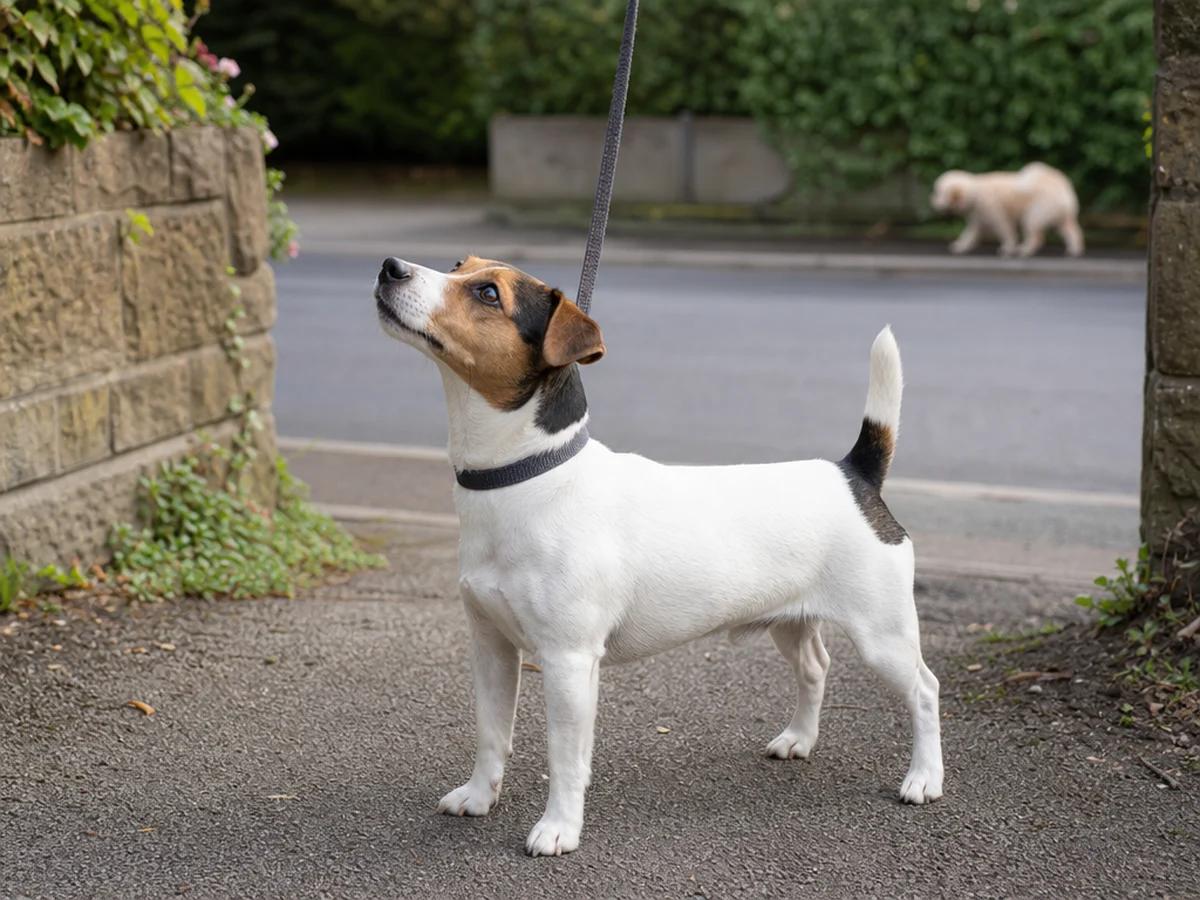
The Rehearsed Turn
Practice a cheerful turn cue indoors and on quiet walks. Say the cue, rotate away and reward after several steps. Build fluency without another dog present. In a real encounter, use the turn while there is still space, not after the leash is tight.
The Street Cross
Teach the dog to follow a diagonal path across an empty street or into a broad driveway when traffic conditions are safe. The diagonal keeps movement flowing and increases distance. Check vehicles first. If crossing is unsafe, use the turn or a visual screen instead.
The Visual Screen
Move behind a parked vehicle, hedge, solid fence or building corner. A screen interrupts staring and gives the dog time to recover. Do not trap the team in a dead end. The handler should know the exit before stepping behind cover.
Carry food in an accessible pouch, but do not lure the dog closer to a trigger. Rewards happen after movement toward safety. If the dog cannot eat, create more distance and keep leaving. Appetite is information about arousal, not a test of character.
Practice all three exits on ordinary walks. A route is not an emergency tool until the handler can perform it smoothly while holding the leash, scanning traffic and breathing normally.
Calm Passing in a Jack Russell Terrier Aggression Plan
Choose a wide location with predictable sight lines and a helper dog who can remain neutral at a great distance. Both handlers should agree on paths and an abort signal. Begin far enough apart that the Jack Russell Terrier can notice, eat and move with a loose body.
Parallel Movement With an Offset
Walk in the same direction rather than toward each other. Keep one team well ahead and across the space. Reward the terrier for glancing at the other dog and then returning attention to the route. The reward lands away from the other dog.
End after a few successful passes. Do not reduce distance automatically within the session. Calm repetition at one workable gap builds a clearer history than a steady approach until something goes wrong.
The UKC describes the Jack Russell Terrier as bold, active and alert. Alertness means the dog may notice movement early. Use that early notice as the moment to reinforce turning back, not as a reason to march closer.
Progress includes softer posture, quick recovery after a glance, the ability to sniff and a willingness to follow an exit. Silence alone is not enough. A quiet dog who remains rigid and staring still needs distance.
Dog Greetings in an Aggression Plan
Many dogs do not need on-leash greetings. Tight leashes, direct approaches and limited escape routes can make greeting harder than walking past. If the goal is calm public behavior, successful non-contact passes may be the complete skill.
Do not allow an unfamiliar owner to promise that another dog is friendly and close the gap. Friendly intent does not guarantee compatible play or a safe approach. Use a clear phrase such as, "We need space, thank you," and take the rehearsed exit.
If a qualified professional recommends a greeting, use carefully selected dogs, ample space and brief curved approaches. End at the first increase in stiffness or intensity. A greeting should never be used to prove that aggression is cured.
The site's guide to Jack Russell Terrier socializing covers broader exposure. Socialization means building safe, useful experiences. It does not require physical interaction with every dog.
Home Management for Jack Russell Terrier Aggression
Conflict between household dogs needs a separate traffic plan. Feed in separate closed rooms, pick up bowls afterward and manage high-value chews, toys, beds and doorways. Use gates or doors to create true separation. A person standing between aroused dogs is not a reliable barrier.
Schedule individual rest and activity. Shared excitement at windows, visitors or yard fences can spill into conflict between dogs who normally coexist. Block the view, call dogs away early and separate before opening exterior doors.
Do not reach between fighting dogs or grab collars with bare hands. Emergency separation carries serious bite risk. Ask a qualified professional to create a household-specific safety procedure before another incident occurs.
Children should never supervise dog interactions or mediate access to resources. Adults control doors, barriers and schedules. Every family member should know which spaces belong to each dog and when barriers must remain closed.
When cats or small animals are part of the home, use the site's separate guide on how to train around prey animals. Predatory behavior and dog-directed aggression can look intense for different reasons, so one plan should not be copied onto the other.
Aggression Evidence Without Blame
Keep a short encounter record. Use observable facts rather than words such as bad, jealous or dominant. Helpful entries include:
- Location, path width and available exits.
- Estimated distance when the dog first noticed the trigger.
- Ear, mouth, body and movement changes before barking or lunging.
- The handler's first action and whether distance increased.
- Time needed for sniffing, eating and loose movement to return.
Review the record weekly. One route may repeatedly create blind corners. One time of day may bring more off-leash dogs. Change those conditions first. Training cannot compensate for a route that supplies unavoidable close encounters.
Include successful exits and calm observations. A record containing only explosions hides the distances where the dog can learn. Improvement may first appear as fewer surprises and faster recovery, not closer passing.
Do not deliberately recreate the worst event to measure progress. A safe plan collects evidence below threshold. Controlled distance allows learning while a full reaction mostly rehearses the old sequence.
Qualified Help for Jack Russell Terrier Aggression
Arrange coordinated veterinary care and consult a credentialed behavior specialist who uses rewards for any bite, fight, redirected aggression, rapidly worsening behavior or household conflict. Share the history, encounter record, equipment and home layout. Medical findings and behavior observations should inform one coordinated plan.
Choose methods that create distance, preserve warning signals, reinforce usable choices and protect all animals. Ask how sessions will prevent close-contact rehearsals, how progress will be measured and what the household should do between appointments. The answers should match the safety plan already in place.
Expect the first phase to focus on predictability. Routes may become quieter, shared spaces may run on schedules and greetings may disappear. These changes are part of the support plan because they lower the number of emergencies the dog must navigate.
Long-term success may be selective. A Jack Russell Terrier might learn to pass dogs across a street, relax behind a gate and live on a carefully managed schedule without enjoying close greetings. That is meaningful progress. Start today by choosing one route with an early exit and rehearsing the turn when no other dog is present.
 BehaviorA Bored Jack Russell Terrier Invents Jobs, So Offer Chews
 Puppy trainingTeaching Bite Control to a Jack Russell Terrier Puppy
 Puppy trainingYour 4 Month Old Jack Russell Terrier Starts Testing Every Rule